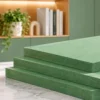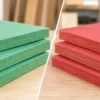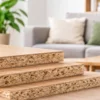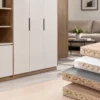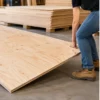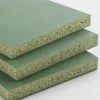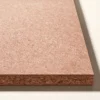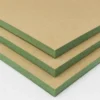

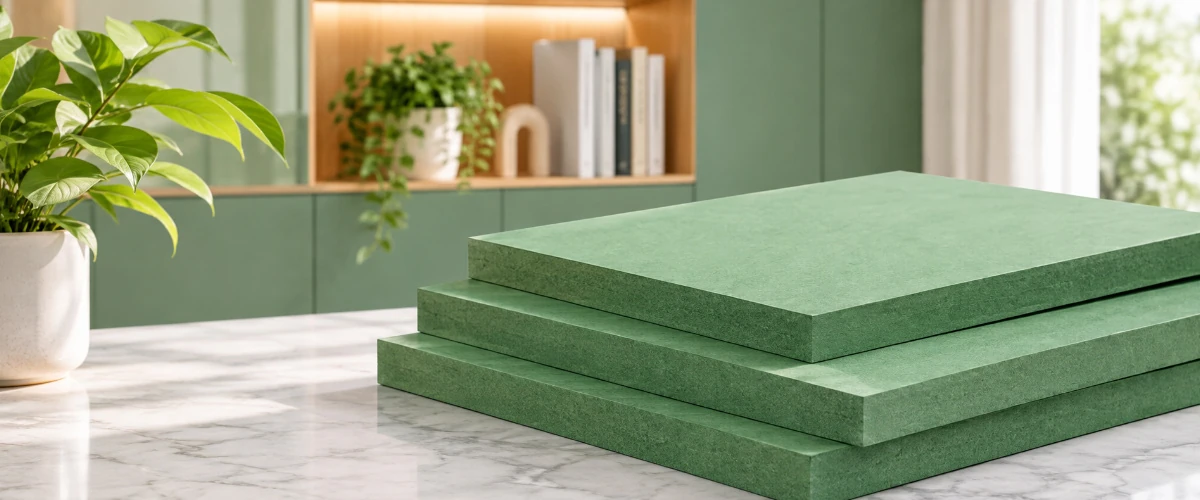
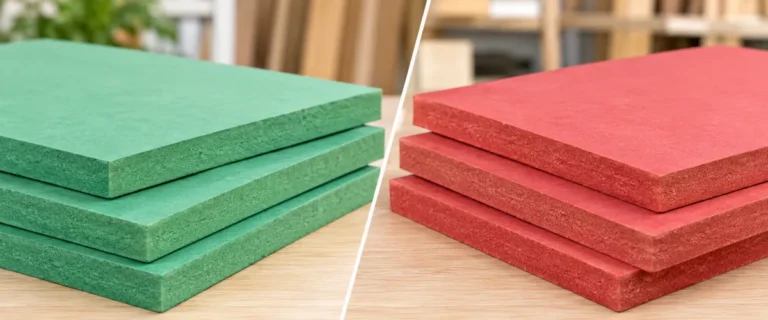
If you walk into a BAITWOOD panel factory, you’ll see stacks of MDF boards in different colors, including light brown, red, and green. Each color usually represents a different MDF type with its own features and performance. In this article, we’ll focus on one common type: Green MDF. We’ll take a closer look at its features, performance, and practical uses.
Green MDF is a type of moisture-resistant medium-density fiberboard specially treated to perform better in areas with higher humidity than normal indoor spaces. Unlike standard MDF, manufacturers use special resin formulations and moisture-resistant additives during production. These help the board resist moisture and reduce thickness swelling when it absorbs moisture.
You can usually identify Green MDF by its green-colored core. However, the color alone does not determine its moisture resistance. The actual performance depends on the raw materials, resin system, and manufacturing process.
In this guide, we’ll explain what Green MDF is, how it differs from standard MDF, and where you can use it. We’ll also share some practical buying tips to help you choose the right MDF board for your project.
What Is Green MDF?
Green MDF, also known as moisture-resistant MDF or MR MDF, is an engineered wood panel designed to handle damp conditions better than standard MDF.
Manufacturers make MDF from wood fibers or other plant-based fibers. They blend these fibers with synthetic resin adhesives and press the mixture under high temperature and pressure to form solid panels. Green MDF typically has a density of 0.65–0.80 g/cm³.
Compared with standard MDF, Green MDF offers better moisture resistance and lower thickness swelling. Manufacturers also add green pigment to the core, making it easier for buyers to identify its moisture-resistant grade.
However, Green MDF is not waterproof. It can still absorb moisture and swell when exposed to standing water or prolonged damp conditions.
To learn more about the materials and manufacturing methods used in MDF production, read our guide to MDF Board: Composition, Manufacturing, and Uses.
Common Specifications of Moisture-Resistant MDF
Moisture-resistant MDF is available in a range of thicknesses and panel sizes to suit different applications.
Common Thicknesses
| Thickness Type | Common Thicknesses |
|---|---|
| Thin Boards | 3mm, 5mm, 6mm |
| Medium Thickness | 9mm, 10mm, 12mm |
| Thick Boards | 15mm, 18mm |
| Extra-Thick Boards | 22mm, 25mm and above |
Common Panel Sizes
| Panel Size | Size Type |
|---|---|
| 1220 × 2440mm | Standard Size |
| 1220 × 2800mm | Extended Size |
| 1220 × 3050mm | Extended Size |
| Custom Sizes | Available Based on Project Requirements |
Buying Tips
- Check the Density: Moisture resistance depends on more than just the surface treatment. The density of the core material also plays an important role. Higher-density MDF, such as boards with a density of 680 kg/m³ or above, generally offers better stability and moisture resistance.
- Choose the Right Thickness: For humid areas such as kitchens and bathrooms, consider MDF with better moisture resistance. Panels in 12 mm or 15 mm thickness can provide better support and stability for many applications.
Key Features and Applications of Moisture-Resistant MDF
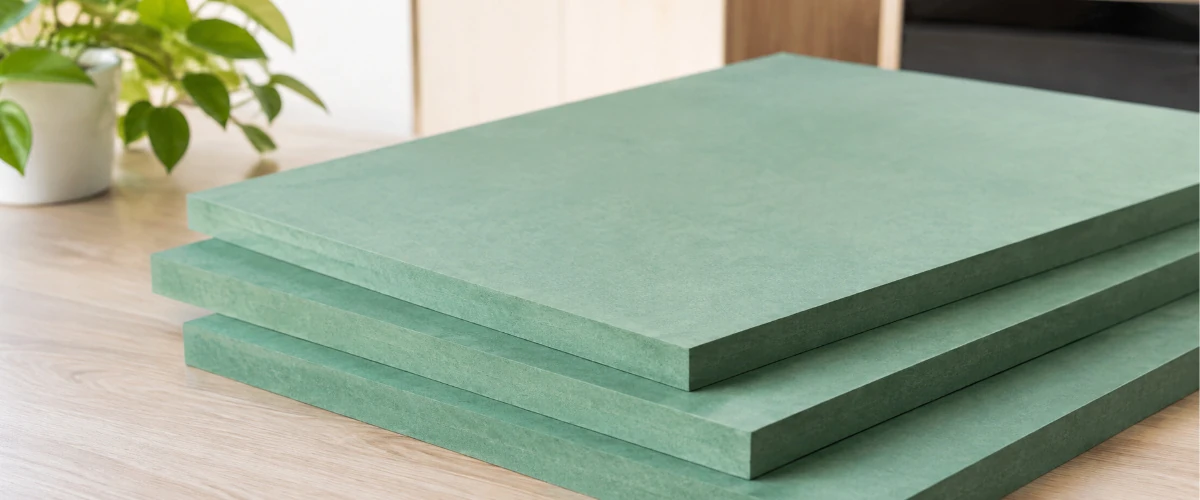
Moisture-resistant MDF offers a uniform structure, a dense core, good mechanical strength, and excellent workability. These features make it a popular choice for furniture, flooring, composite doors, and interior decoration.
Its smooth, even surface makes it easy to apply different finishes without extensive sanding. You can cover it with wood veneer, PVC film, or paint to achieve different looks and styles.
The board also offers good bending strength and dimensional stability. Its uniform core helps it support loads and maintain its shape during normal use. With proper installation and care, it is less likely to crack or warp.
Moisture-resistant MDF also works well with various processing methods, including laminating, painting, carving, and CNC routing. Manufacturers use it to make decorative cabinet doors in French, Chinese, and European styles. It is also a common choice for decorative wall panels, TV feature walls, and custom furniture.
With its combination of practical performance and design flexibility, moisture-resistant MDF offers a versatile solution for a wide range of interior projects.
Green MDF vs. Regular MDF: What Are the Differences?
Green MDF and regular MDF share a similar manufacturing process and fiber-based structure. However, their moisture resistance and intended applications differ.
| Feature | Green MDF | Regular MDF |
|---|---|---|
| Main Purpose | Indoor applications with higher humidity | General indoor applications |
| Moisture Resistance | Improved | Limited |
| Core Color | Usually green | Usually natural brown |
| Water Absorption | Lower when properly manufactured | Generally higher |
| Thickness Swelling | Better resistance | More susceptible to swelling |
| Surface Finish | Paint, veneer, laminate, and melamine | Paint, veneer, laminate, and melamine |
| Common Uses | Kitchen cabinets, bathroom furniture, storage units | Bedroom furniture, office furniture, cabinets |
The main difference lies in their moisture-resistant properties.
Regular MDF works well in dry indoor environments. Green MDF provides an additional level of protection in areas where humidity may cause standard MDF to swell.
If you also want to understand the differences between moisture-resistant and fire-retardant MDF, read our article on Green MDF vs Red MDF: Differences, Uses, and Properties.
For general furniture and interior projects that do not require additional moisture resistance, you can also consider our Raw MDF.
Is Green MDF Waterproof?
No. Green MDF is moisture-resistant, not waterproof.
Its special resin formulation helps reduce water absorption and thickness swelling. However, the board can still absorb moisture through exposed surfaces and edges.
If you plan to use green MDF in a kitchen or bathroom, follow these recommendations:
- Seal all exposed edges with suitable edge banding or protective coatings.
- Apply an appropriate surface finish to protect the board.
- Keep the panels away from standing water and direct water exposure.
- Ensure proper ventilation in humid rooms.
- Use suitable installation methods to prevent water from entering joints.
For areas with frequent direct water contact, consider PVC boards, WPC panels, or other waterproof materials.
Buying Tips: What to Check Before Purchasing Green MDF
Before buying Green MDF, check its surface, density, moisture resistance, and thickness. Choose boards with a smooth, even surface and no visible scratches, dents, cracks, or delamination. The typical density ranges from 0.65 to 0.80 g/cm³. For moisture resistance, check whether the manufacturer uses moisture-resistant additives throughout the core rather than relying only on a surface coating. Also, choose the right thickness for your project: 9 mm or less for lightweight wall panels and partitions, 12 mm for shelves, cabinet doors, and decorative parts, and 15 mm or thicker for cabinet sides and base panels. Finally, check for any strong chemical odors and review the product label or certificate to confirm the manufacturer’s details and applicable quality standards.
Conclusion
Green MDF is a practical choice for furniture manufacturing and interior decoration projects that require better moisture resistance than standard MDF.
Its smooth surface, easy processing, and improved dimensional stability make it suitable for kitchen cabinets, bathroom furniture, storage units, and other indoor applications.
However, buyers should remember that green MDF is not waterproof. Proper surface finishing, edge sealing, and installation are essential for long-term performance.
BAITWOOD supplies MDF and other wood-based panels for furniture manufacturers, distributors, wholesalers, and project buyers. We support different product specifications and customized requirements.
Product Recommendations
Find the Right Products for Your Needs
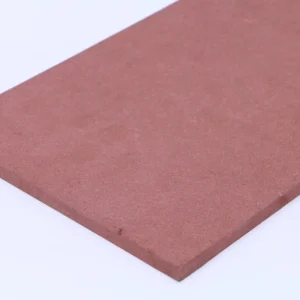 Baitwood ProductFire Resistant MDFFire Resistant MDF Board (FR MDF) is a high-quality engineered wood panel treated with…View Product
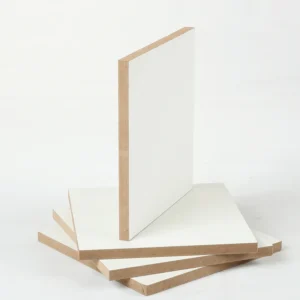 Baitwood ProductMelamine MDFMDF (Medium Density Fiberboard) is an engineered wood panel made from refined wood fibers…View Product
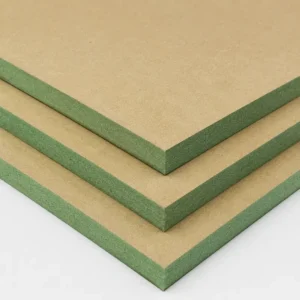 Baitwood ProductMoisture Resistant MDFMoisture Resistant MDF is a high-performance engineered wood panel designed to offer better moisture…View Product
Related Articles
Explore more helpful articles, product guides, and expert tips.
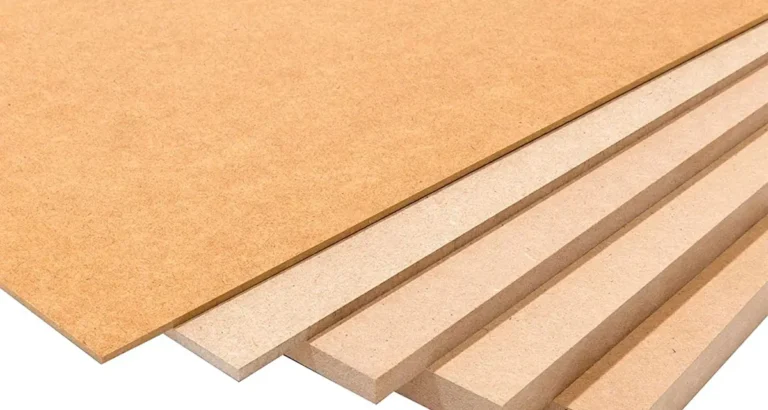 Blog ArticleIs MDF Really Banned in the USA? The Truth RevealedWhat Is MDF? Medium Density Fiberboard (MDF) is a widely used engineered wood product made…Read Article
 Blog ArticleGreen MDF vs Red MDF: Differences, Uses, and PropertiesMedium Density Fiberboard (MDF), also known as medium-density fiberboard, usually has a light cream color.…Read Article
 Blog ArticleCommon Uses of MDF in Furniture ManufacturingMedium Density Fiberboard (MDF) is one of the most widely used engineered wood products in…Read Article