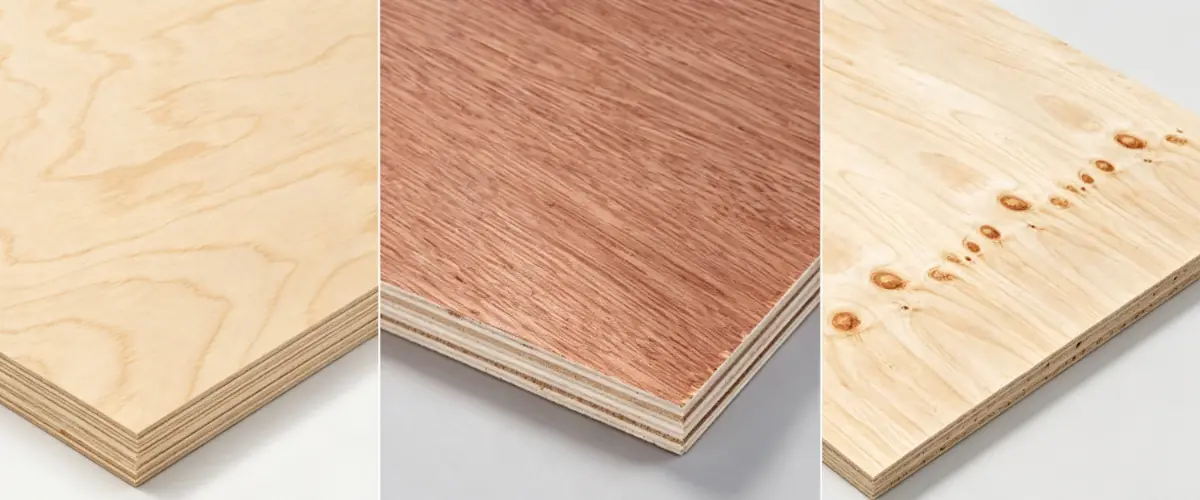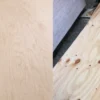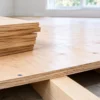

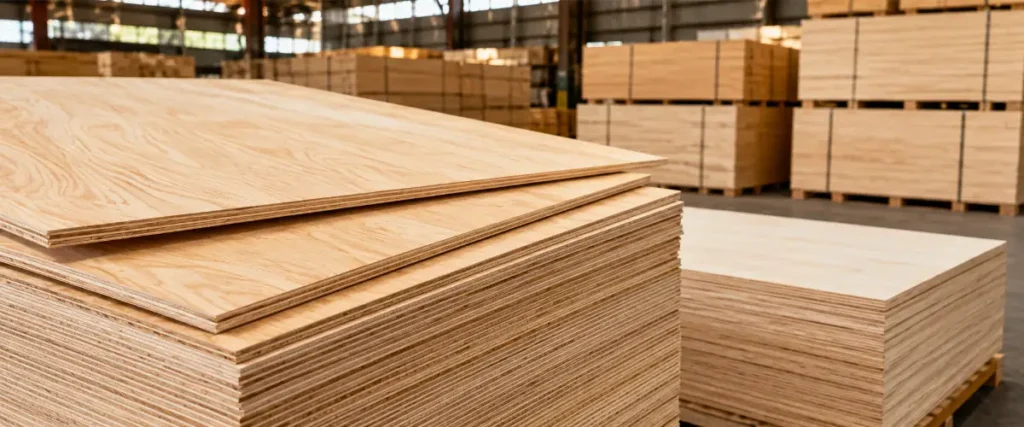
Commercial‑grade plywood is one of the fundamental and essential engineered wood panels for industrial and construction‑related sectors. Unlike ordinary plywood, premium commercial plywood adopts fine‑grade face veneers including okoume, bintangor, eucalyptus and poplar. Its sand‑finished face stays flat and smooth.
For importers, distributors, furniture manufacturers and project purchasers, knowledge of its manufacturing workflow helps evaluate panel quality, structural stability and batch‑to‑batch consistency. This article takes an in‑depth look into how commercial plywood is produced.
What Is Commercial Plywood?
Commercial‑grade plywood is a processed multi‑layer wood panel bonded from thin wood veneers. Wood grain of adjacent veneers is generally arranged perpendicularly to improve its dimensional stability and mechanical strength.
Based on market demands and usage scenarios, commercial‑grade plywood can be manufactured from various timber species.
Common wood materials cover poplar, eucalyptus, birch and mixed hardwoods. Thanks to high cost‑performance, poplar and eucalyptus plywood enjoys the widest‑ranging applications in commercial packaging and construction formwork.
Commercial Plywood Production Process
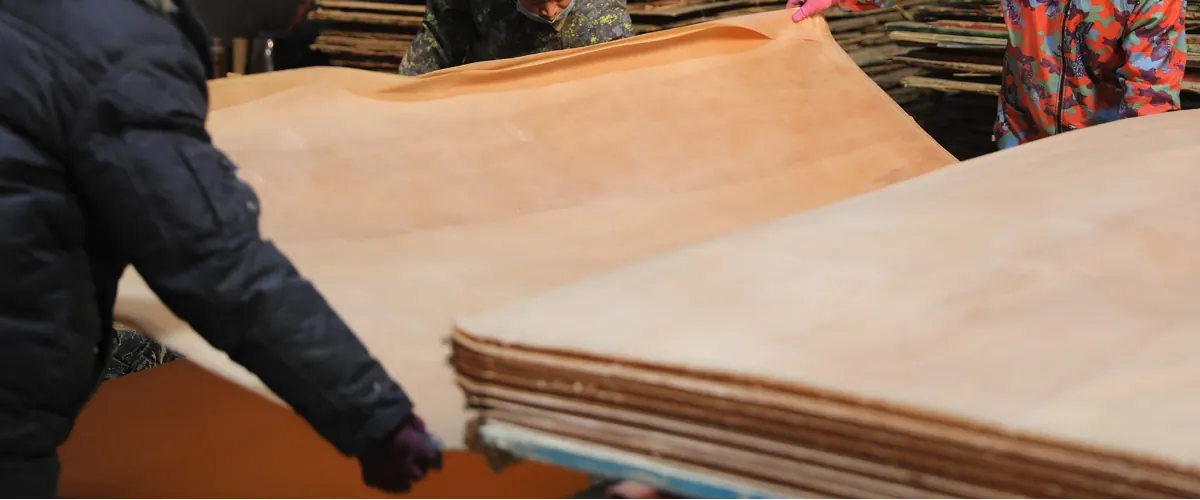
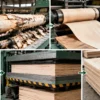
The manufacturing process can be divided into several important stages.
1. Log Selection
The production process starts with selecting suitable logs. Manufacturers consider wood species, diameter, moisture condition, defects, and overall quality.
Good-quality logs help produce veneers with better appearance, thickness consistency, and bonding performance.
For commercial plywood, the choice of raw material also affects the panel’s strength, density, surface quality, and price.
2. Veneer Peeling
Selected raw logs go through pretreatment and processing by a veneer rotary‑cutting lathe. The log rotates against a long cutting blade to yield continuous thin wood veneers, whose thickness normally ranges from 0.3 mm to 3 mm.
Veneer thickness is determined by plywood specifications and production requirements. Commercial‑grade plywood comes with a wide selection of veneer thicknesses, covering ultra‑thin face veneers and thicker core veneers.
3. Veneer Drying
Fresh‑rotary‑cut wet veneers feature high moisture content and need drying prior to gluing.
Industrial veneer dryers adjust moisture to plywood‑production‑ready levels, with a strict target range of 8%‑12%.
Consistent veneer moisture is critical for manufacturing premium commercial‑grade plywood.
4. Veneer Grading and Repair
After drying, veneers are sorted according to their quality and intended position in the plywood panel.
Better-looking veneers are normally selected for the face and back, while veneers with more visible defects may be used in the core.
Depending on the production line, manufacturers may also repair veneer defects such as holes, cracks, or open areas before assembly.
5. Glue Application
Prior to veneer assembly into plywood, blended‑up adhesive (urea‑formaldehyde resin and phenol‑formaldehyde resin are mainstream choices) gets evenly coated onto veneer faces.
Plywood manufacturers pick varied adhesive systems based on required panel properties, end‑use conditions and formaldehyde emission standards.
Conventional commercial‑grade plywood adopts matched adhesive formulations to secure adequate bonding strength and dimensional stability for indoor and general‑purpose applications.
6. Veneer Lay-Up
The glued veneers are stacked layer‑by‑layer to form plywood.
Layers are arranged following the odd‑layer cross‑grain principle. The grain direction of adjacent veneers intersects at roughly 90°. This cross‑laminated structure counteracts internal wood stress and prevents subsequent panel deformation.
The total number of veneer layers is determined by the target plywood thickness.
For example:
- Thin plywood may use fewer veneer layers.
- Medium-thickness plywood uses several layers.
- Thick plywood requires more veneer layers and a carefully balanced core structure.
7. Cold Pressing
The stacked veneer stack is pre‑pressed under cold pressure, with pressing duration ranging from 10 to 60 minutes.
Cold pressing compacts all face veneers and builds reliable initial adhesion prior to hot‑pressing.
Besides, it stabilises the whole panel blank and stops veneer shifting in the following‑up manufacturing procedure.
8. Hot Pressing
Hot‑pressing ranks among the most vital procedures during commercial‑grade plywood manufacture. Assembled veneer blanks are loaded into hot‑press machines. Under high‑temperature heat (typically 105°C‑170°C) and heavy compression, adhesive gets activated and cured, while pressure tightly compresses every veneer layer.
Proper hot‑press settings bring these benefits:
- Firm inter‑layer bonding
- Uniform panel thickness
- Excellent dimensional stability
- Lower risk of veneer delamination
Pressing parameters shall be adjusted according to wood species, panel thickness, adhesive category and manufacturing specifications.
9. Panel Trimming and Sanding
After pressing, the plywood panels are trimmed and cut to the required dimensions. Common commercial plywood sizes include 1220 × 2440 mm and 1250 × 2500 mm, while customized sizes are also available according to customer requirements. Accurate trimming helps ensure consistent panel dimensions for further processing and end-use applications.
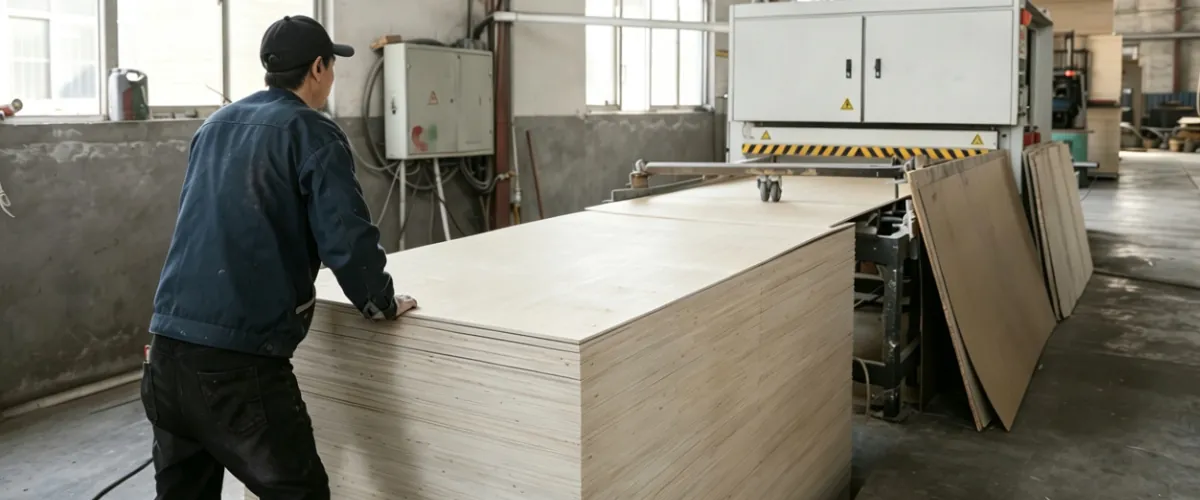
After trimming, the plywood surface is sanded to improve its smoothness, flatness, and thickness uniformity. Sanding also enhances the appearance of the face veneer and prepares the panels for further processing, such as painting, laminating, veneering, or furniture manufacturing. Depending on product specifications and customer requirements, commercial plywood can be supplied with different surface grades.
10. Quality Inspection
Before packaging and shipment, finished plywood is inspected according to production and customer requirements.
Typical quality checks include:
- Panel dimensions
- Thickness tolerance
- Surface appearance
- Veneer quality
- Moisture content
- Bonding quality
- Core construction
- Warping and other defects
For B2B buyers, consistent quality from batch to batch is especially important when purchasing plywood in large quantities.
Commercial Plywood Manufacturing Process Flow
The complete production process can be summarized as:
Log Selection → Veneer Peeling → Veneer Drying → Veneer Grading → Glue Application → Veneer Lay-Up → Cold Pressing → Hot Pressing → Trimming → Sanding → Quality Inspection → Packaging
Each stage affects the final performance and appearance of commercial plywood.
Why Understanding the Production Process Matters for Importers
For importers and distributors, understanding the commercial plywood manufacturing process makes it easier to evaluate suppliers.
Instead of comparing suppliers only by price, buyers can ask about the raw materials, veneer thickness, adhesive, pressing process, sanding quality, and inspection procedures.
This can help reduce problems such as inconsistent thickness, poor bonding, excessive warping, and surface defects.
Conclusion
The commercial plywood production process involves multiple carefully controlled stages, from log selection and veneer peeling to drying, gluing, pressing, sanding, and final inspection.
For B2B buyers, understanding how commercial plywood is manufactured provides useful information when comparing suppliers and selecting products for furniture, cabinets, interior decoration, packaging, and other applications.
At Baitwood, we can provide commercial plywood in different wood species, sizes, thicknesses, and surface options according to customer requirements. Contact us to discuss your plywood sourcing needs.