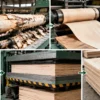

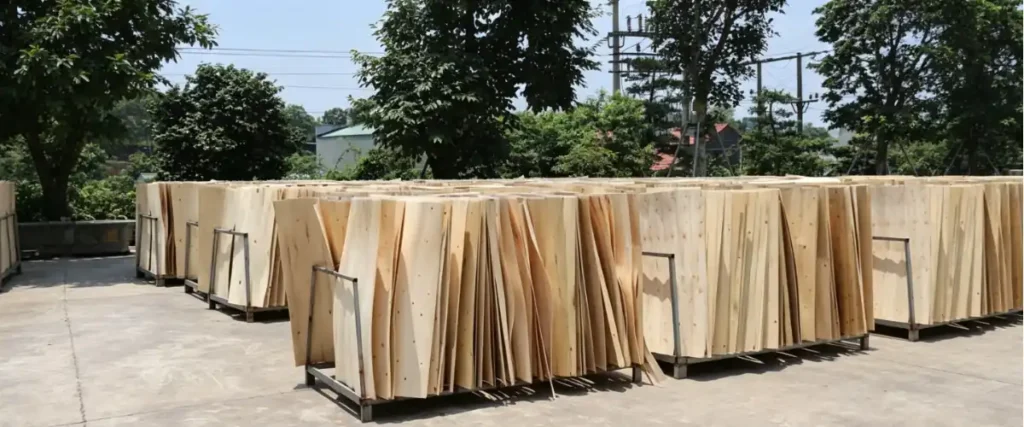
Veneer drying stands as the most‑critical procedure in plywood.
After logs are debarked, freshly‑cut thin wood veneers contain massive moisture. The moisture content of wet veneers can reach 60%‑100%, making them unfit for premium‑grade plywood production. Excessive moisture weakens adhesive bonding performance, triggers hot‑pressing defects, raises the risk of veneer delamination and undermines the dimensional stability of finished plywood.
It is essential for plywood producers to control veneer moisture content prior to gluing and hot‑pressing. In short, proper veneer‑drying work lays a solid foundation for plywood production.
Why Must Veneers Be Dried Before Plywood Production?
There are several important reasons why veneer drying is necessary in plywood manufacturing:
1. To Improve Adhesive Bonding
Properly dried veneers allow the adhesive to bond evenly between veneer layers. Excessive moisture can interfere with glue curing and create problems such as weak bonding, blisters, and delamination during hot pressing.
2. To Control Veneer Moisture Content
Veneer moisture content must be controlled within a suitable range, often around 6%–12%, depending on the wood species, adhesive, plywood type, and production conditions. Proper moisture control helps maintain consistent bonding and production quality.
3. To Improve Plywood Stability and Reduce Defects
Uneven or excessive moisture can cause shrinkage, warping, thickness variation, internal stress, and dimensional instability. Properly dried veneers help manufacturers produce flatter and more stable plywood panels.
4. To Improve Hot Pressing and Surface Quality
Excess moisture can generate steam pressure during hot pressing, affecting pressing time, adhesive curing, and final panel quality. Proper veneer drying helps reduce surface defects such as wrinkles, buckling, roughness, and uneven surfaces.
In short, veneer drying is essential for achieving strong bonding, stable dimensions, efficient hot pressing, and consistent plywood quality.
What Happens If Veneers Are Not Dried Properly?
Skipping or poorly controlling the veneer drying process can create multiple problems throughout plywood production.
| Problem | Possible Cause | Effect on Plywood |
|---|---|---|
| Weak bonding | Excessive veneer moisture | Reduced bonding strength |
| Delamination | Steam pressure or poor adhesive curing | Layers separate |
| Warping | Uneven moisture content | Panel deformation |
| Blisters | Excess moisture during pressing | Surface defects |
| Glue failure | Improper moisture level | Poor adhesion |
| Thickness variation | Uneven pressing conditions | Inconsistent panels |
| Cracking | Over-dried veneers | Veneer damage |
| Poor surface quality | Improper drying | Appearance defects |
This is why veneer drying is not an optional step in professional plywood manufacturing.
What Is the Ideal Moisture Content for Plywood Veneers?
There is no single moisture content that applies to every plywood product.
The appropriate target depends on:
- Wood species
- Veneer thickness
- Adhesive type
- Plywood grade
- Production equipment
- Pressing temperature
- End-use requirements
As a general production reference, many plywood manufacturers aim for veneer moisture content in the range of approximately 6%–12% before gluing.
However, the exact target should be determined according to the manufacturer’s production process and adhesive requirements.
For example, veneers used for different plywood products may require different moisture control strategies.
The key is consistency, not simply achieving the lowest possible moisture content.
Does Veneer Drying Affect Different Types of Plywood?
Yes.
Different plywood products have different performance requirements, but proper veneer moisture control is important across most plywood categories.
Commercial Plywood
Stable veneer moisture helps improve bonding and reduce warping.
Furniture Plywood
Moisture control contributes to better surface quality and dimensional stability.
Film Faced Plywood
Good bonding between veneer layers is important because film faced plywood is often used repeatedly in construction formwork.
Structural Plywood
Consistent bonding strength and dimensional stability are critical for load-bearing applications.
Packaging Plywood
Stable panels are important for producing reliable crates, boxes and industrial packaging structures.
Veneer Drying vs. Natural Air Drying
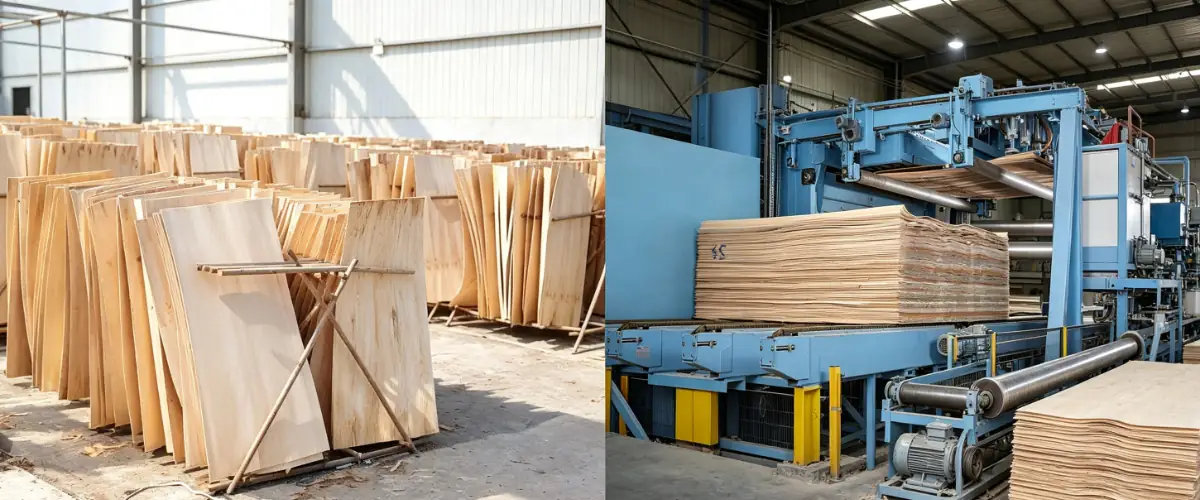
Small-scale wood processing may use natural air drying, but industrial plywood production normally requires controlled mechanical drying.
| Feature | Natural Air Drying | Industrial Veneer Drying |
|---|---|---|
| Drying speed | Slow | Fast |
| Moisture control | Less precise | More precise |
| Production volume | Limited | High |
| Weather dependence | High | Low |
| Uniformity | Variable | More consistent |
| Suitable for mass plywood production | Limited | Yes |
For large-scale plywood manufacturing, industrial drying provides much better control over production speed and veneer moisture content.
Why Veneer Drying Matters to Plywood Buyers
For importers, the veneer drying process may seem like a technical manufacturing detail.
However, it directly influences the plywood you receive.
A well-controlled veneer drying process can contribute to:
- More consistent plywood quality
- Better bonding strength
- Lower delamination risk
- Better dimensional stability
- More consistent thickness
- Better surface quality
- More reliable production batches
- Fewer quality complaints
For B2B buyers purchasing large volumes of plywood, these factors can have a direct impact on project costs and customer satisfaction.
Conclusion: Veneer Drying Is the Foundation of Stable Plywood Quality
So, why must veneers be dried before plywood production?
Because veneer moisture affects almost every critical stage of plywood manufacturing—from glue bonding and hot pressing to dimensional stability and final product quality.
Proper veneer drying helps manufacturers control moisture, improve bonding, reduce delamination risks, minimize warping and produce more consistent plywood panels.
For plywood buyers, understanding the veneer drying process can also help when evaluating suppliers and comparing plywood quality.
A reliable plywood manufacturer should have a controlled process covering veneer peeling, drying, moisture inspection, grading, gluing, lay-up and hot pressing.
At Baitwood, consistent raw material selection and controlled plywood production are essential for supplying plywood for construction, furniture, packaging, formwork and other industrial applications.
Looking for a reliable plywood supplier for your next project?
Contact Baitwood to discuss your required plywood species, thickness, core structure, adhesive and packaging specifications.