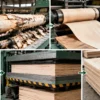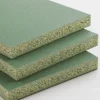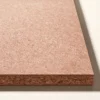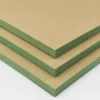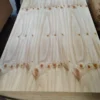

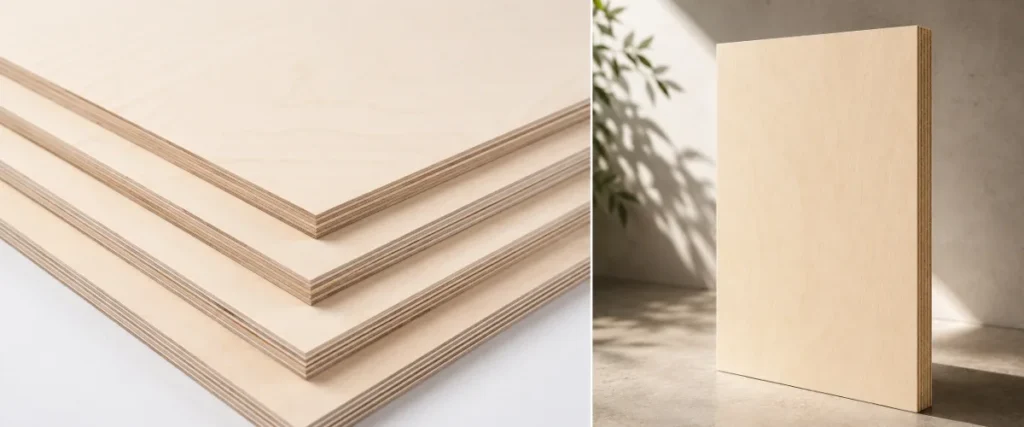
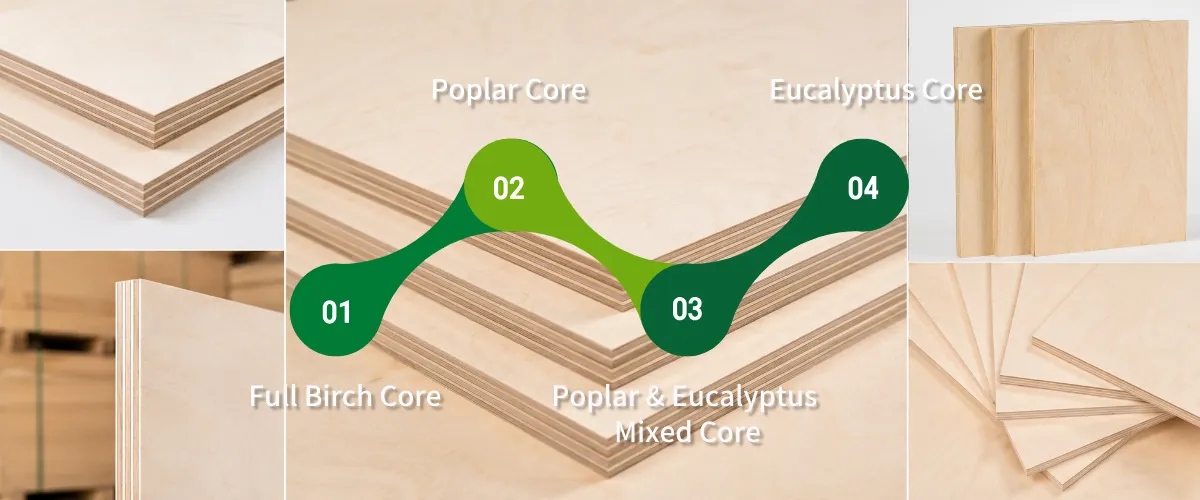
At BAITWOOD, we manufacture birch plywood with four carefully selected core options:
- Full Birch Core
- Poplar Core
- Eucalyptus Core
- Poplar & Eucalyptus Mixed Core
Quick Comparison of Birch Plywood Core Types
If you’re looking for a quick answer, the table below summarizes the main differences between the four birch plywood core materials.
| Core Type | Strength | Weight | Screw Holding | Stability | Cost | Best Applications |
|---|---|---|---|---|---|---|
| Full Birch Core | Excellent | Heavy | Excellent | Excellent | High | Premium furniture, CNC machining, high-end cabinetry |
| Poplar Core | Good | Light | Good | Good | Low | Cabinets, interior decoration, lightweight furniture |
| Eucalyptus Core | Very Good | Medium-Heavy | Very Good | Very Good | Medium-High | Outdoor furniture, heavy cabinetry, construction formwork, moisture-prone indoor projects |
| Poplar & Eucalyptus Mixed Core | Very Good | Medium | Very Good | Very Good | Medium | Furniture, commercial projects, construction panels |
Quick Recommendation
Choose Full Birch Core if you need maximum strength, excellent screw-holding ability, and long-term durability.
Choose Poplar Core if lightweight construction and cost efficiency are your priorities.
Choose Pure Eucalyptus Core if you need higher density, moisture resistance and solid structural performance without the premium cost of full birch plywood.
Choose Poplar & Eucalyptus Mixed Core if you want the best balance between strength, stability, and price.
How Core Material Affects Birch Plywood Performance
The core is the structural foundation of plywood. It influences nearly every aspect of the finished panel, from machining performance to service life.
Understanding these performance factors will help you select the most suitable birch plywood for your application.
1. Strength and Load-Bearing Capacity
Strength is one of the first considerations when choosing plywood.
Because birch wood has a relatively high density, Full Birch Core plywood provides exceptional bending strength and impact resistance. It is ideal for heavy-duty furniture, worktops, shelving, and applications where panels must support significant loads.
Poplar is much lighter and softer than birch, making Poplar Core plywood easier to handle but less suitable for heavy structural applications.
Pure Eucalyptus Core features high wood density, far exceeding poplar in tensile strength and bending resistance. It delivers rigid structural performance and can bear heavy loads, which makes it suitable for load-bearing cabinet frames and semi-outdoor wooden products. Its strength is second only to full birch core.
Poplar & Eucalyptus Mixed Core combines lightweight poplar with denser eucalyptus veneers, providing improved strength without significantly increasing weight. This balanced construction makes it one of the most popular choices for furniture manufacturers and export markets.
2. Panel Weight
Weight directly affects transportation costs, installation efficiency, and furniture usability.
Poplar Core is the lightest option, making it ideal for projects requiring easy handling or reduced shipping costs.
Eucalyptus Core has medium-heavy weight thanks to its high density. It is heavier than poplar core but noticeably lighter than full birch core, striking a nice balance between solid structure and manageable weight.
Full Birch Core is considerably heavier due to the higher density of birch veneers. Although heavier, this additional weight contributes to superior strength and stability.
Mixed Core offers a practical compromise, reducing weight while maintaining good structural performance.
3. Screw-Holding Performance
For cabinets, furniture, and assembled products, screw-holding capacity is critical.
Full Birch Core provides the strongest screw retention because of its dense and uniform internal structure. Screws remain secure even after repeated assembly and disassembly.
Eucalyptus Core owns tight wood grain and high density, so it achieves very good screw holding power. Fasteners stay firmly locked inside the veneers and will not loosen easily under long-term use.
Poplar Core offers acceptable performance for general furniture but may not be suitable for products requiring heavy-duty fastening.
The Poplar & Eucalyptus Mixed Core improves screw-holding performance by incorporating stronger eucalyptus veneers, making it suitable for a wide range of furniture applications.
4. Dimensional Stability & Moisture Resistance
Dimensional stability refers to a plywood panel’s ability to maintain its shape under changes in humidity and temperature.
Full Birch Core generally offers excellent stability due to its consistent veneer density and uniform construction.
Poplar Core performs well in dry indoor environments but may be more susceptible to slight movement under changing moisture conditions.
Eucalyptus wood naturally resists moisture and humidity fluctuations. Pure eucalyptus core birch plywood has minimal expansion and contraction in humid environments, effectively preventing warping or deformation. It works well in kitchens, bathrooms and other damp interior spaces where poplar core plywood cannot hold shape reliably.
Mixed Core combines the flexibility of poplar with the rigidity of eucalyptus, providing very good dimensional stability for most interior applications.
5. Machining and Surface Quality
The quality of the core affects CNC machining, edge finishing, and precision cutting.
Full Birch Core features a dense, consistent internal structure that produces smooth edges with minimal voids, making it ideal for CNC routing, laser cutting, and premium exposed-edge furniture.
Eucalyptus Core has compact inner layers with few gaps. It cuts cleanly during CNC processing and delivers neat edge finishes with fewer burrs. It can meet most precision cutting requirements without extra edge filling work.
Poplar Core machines easily because of its lower density, although edges may require additional finishing depending on the application.
Mixed Core also performs well during machining and provides a good balance between processing efficiency and finished appearance.
6. Cost and Value
Budget is always an important factor when purchasing plywood.
Full Birch Core typically has the highest price because birch veneers are more expensive and provide superior performance.
Eucalyptus Core sits in the medium-high price range. It costs less than full birch plywood but delivers much better density and moisture resistance than poplar core material. It is a cost-effective upgrade choice for projects needing higher structural performance.
Poplar Core is the most economical option, making it suitable for high-volume furniture production and cost-sensitive projects.
Poplar & Eucalyptus Mixed Core occupies the middle ground, offering higher strength than poplar while remaining significantly more affordable than full birch. For many manufacturers, it delivers the best overall value.
Performance Summary
The following rankings provide a quick overview of how the four core types compare across key performance categories.
| Performance Factor | Best Choice | Second Best |
|---|---|---|
| Strength | Full Birch Core | Eucalyptus Core |
| Screw Holding | Full Birch Core | Eucalyptus Core |
| Stability & Moisture Resistance | Full Birch Core | Eucalyptus Core |
| Light Weight | Poplar Core | Poplar & Eucalyptus Mixed Core |
| Lowest Cost | Poplar Core | Poplar & Eucalyptus Mixed Core |
| Mid-range Structural Value | Eucalyptus Core | Poplar & Eucalyptus Mixed Core |
| Overall Value | Poplar & Eucalyptus Mixed Core | Eucalyptus Core |
As you can see, no single core is ideal for every application. The best choice depends on your project’s technical requirements, budget, humidity environment, and expected service life.
Need Help Choosing the Right Birch Plywood?
Every project has different performance and budget requirements, and selecting the right plywood core is essential for achieving the best results.
At BAITWOOD, we offer a complete range of birch plywood with Full Birch Core, Poplar Core, Eucalyptus Core, and Poplar & Eucalyptus Mixed Core. Our team can recommend the most suitable solution based on your application, technical requirements, and target market.
Get in touch with BAITWOOD today to request a free quotation, product catalog, or samples. We’re committed to providing high-quality birch plywood and dependable service to customers worldwide.