
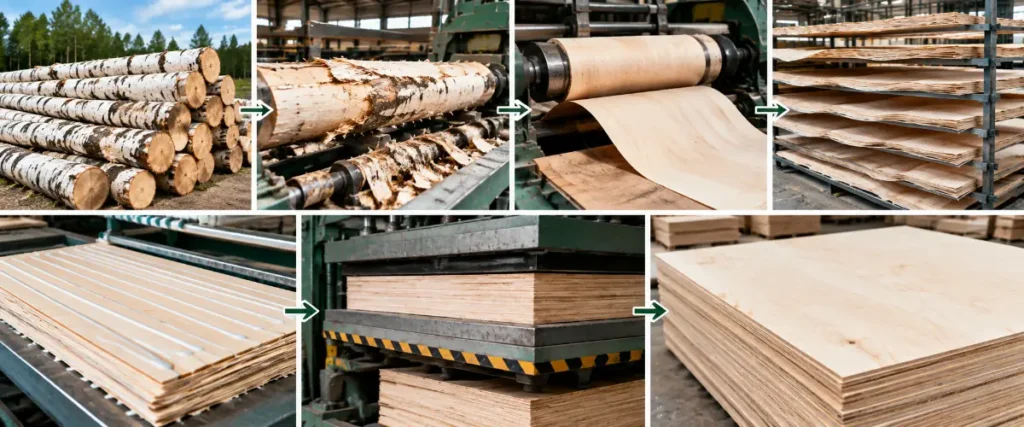
Understanding the birch plywood production process can help buyers choose the right plywood grade and better evaluate product quality, from the selection of birch logs to the final plywood sheets.
1. Log Selection and Pre‑Treatment
Log Selection
High‑quality birch logs with a suitable age and free from serious insect damage and cracks are selected. At large‑scale factories, such as Baitwood plywood factories, logs are typically sourced from sustainably managed forests with FSC certification.
Soaking and Softening
The logs are soaked in hot water at 40°C–45°C. This process softens the wood fibers, helping reduce the risk of veneer cracking during the subsequent rotary peeling process while also improving the veneer yield.
Debarking and Rounding
A debarking and rounding machine is used to completely remove the bark from the logs and shape them into standard cylindrical forms. This not only facilitates subsequent processing but also helps ensure a more uniform veneer thickness during rotary peeling.
2. Rotary Peeling and Drying
Rotary Peeling
The prepared logs are secured in a veneer peeling machine and continuously peeled along the growth rings, much like sharpening a pencil. This process turns the logs into thin wood sheets with a uniform thickness, known as birch veneers.
The veneer thickness is typically 1–3 mm, depending on the required thickness of the finished plywood. After rotary peeling, the veneers are inspected, and any damaged or defective sections are removed before they enter the drying process.
Drying Treatment
Freshly peeled veneers have a high moisture content and therefore need to be dried before further processing. Industrial veneer dryers use controlled heat and airflow to reduce the veneer moisture content to 6%–12%.
If the moisture content is too high, the finished plywood may be more susceptible to mold, deformation, or cracking during subsequent use.
3.Veneer Repair, Grading, Gluing, and Lay‑Up
Veneer Repair and Grading:
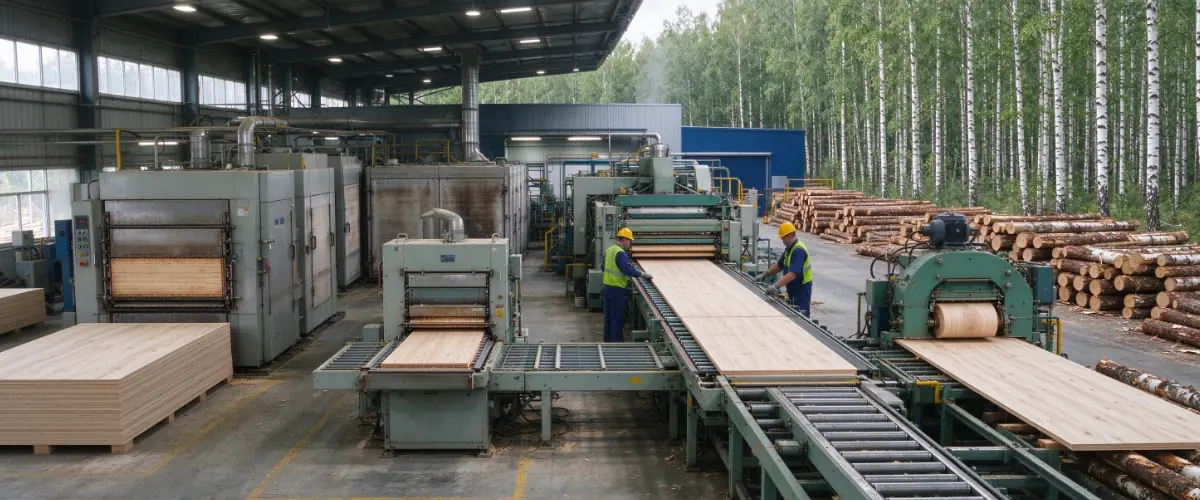
Birch naturally contains knots, small cracks, and other minor defects, so veneer repair is an important step in improving the quality and appearance of the finished plywood. Defective areas are carefully identified and removed, then repaired with high‑quality birch patches. The veneers are also graded according to their grain pattern, color, and surface quality, such as A, B, and C grades.
For applications that require a smooth and attractive surface, higher‑grade veneers are typically selected for the front and back faces.
This grading process is important because the appearance of birch plywood largely depends on the quality of its outer veneer layers.
Adhesive Application:
After the veneers have been prepared, an environmentally friendly adhesive is evenly applied to the surfaces of the dried and repaired veneers. Standard interior plywood commonly uses E0 or E1 urea‑formaldehyde (UF) adhesive, while high‑quality birch marine plywood may use highly water‑resistant phenol‑formaldehyde (PF) adhesive or formaldehyde‑free MDI adhesive.
The adhesive must be applied evenly across the veneer surface. Uneven adhesive application can result in insufficient bonding strength, delamination, and other quality problems.
Veneer Lay‑Up:
The glued veneers are stacked according to an odd‑numbered layer and cross‑grain arrangement. One of the key characteristics of plywood is that adjacent veneer layers are typically arranged with their grain directions perpendicular to each other. This cross‑laminated structure helps balance the internal stresses in the wood and gives the plywood excellent resistance to warping and deformation.
The number of veneer layers depends on the required thickness of the finished plywood. Thicker birch plywood generally contains more veneer layers.
For example, a plywood sheet may consist of multiple layers of thin birch veneers arranged symmetrically around the core. This layered structure provides the panel with greater strength, stability, and resistance to dimensional changes.
4.Hot Pressing, Trimming, and Sanding
Cold Pressing and Hot Pressing:
After the veneers are assembled, the layered sheets are pressed together to form a solid plywood panel.
First, the assembled veneer lay‑up is cold‑pressed to provide initial shaping and stability. It is then transferred to a large hot press, where it is pressed under high temperature and pressure, typically at around 100°C–120°C, for a specified period. This allows the adhesive to fully cure and bonds the multiple veneer layers firmly together.
Hot pressing is one of the most important stages in birch plywood production. Proper pressing conditions help ensure strong bonding, consistent thickness, and good dimensional stability of the finished plywood.
Trimming and Sanding:
The edges of freshly hot‑pressed plywood are usually uneven, so the panels are trimmed with a panel trimming machine to achieve standard dimensions, such as the common 1220 × 2440 mm size.
The panels are then sanded to create a smooth and even surface, remove burrs and rough areas, and maintain accurate thickness tolerances. Sanding also improves the appearance of the front and back veneers and prepares the plywood for further processing.
For furniture and interior decoration applications, a smooth and clean surface is particularly important because the plywood can be directly painted, coated, laminated, or otherwise surface‑finished.
5.Quality Inspection and Packaging
Quality Inspection:
Finished birch plywood undergoes a thorough quality inspection before packaging. Inspectors check key aspects such as surface appearance, dimensions, thickness, bonding quality, and overall panel condition to ensure the plywood meets the required specifications.
Export plywood may also need to meet additional requirements depending on the destination market, applicable standards, and intended application.
Quality control is essential throughout the entire production process because the performance of birch plywood depends on every stage, from log selection and veneer preparation to pressing and final finishing.
When choosing a manufacturer, buyers should also consider production capacity, certifications, quality control, and delivery capability. Our guide on How to Choose a Reliable Birch Plywood Supplier provides more information for importers and distributors.
Packaging and Shipping:
After passing inspection, the finished birch plywood is stacked and packaged according to the customer’s requirements.
Export plywood is typically protected with suitable packaging to reduce the risk of moisture, impact, and surface damage during transportation.
Pallet packaging can also improve handling efficiency, especially during container loading and unloading.
Once packaging is completed, the birch plywood is ready for shipment to distributors, furniture manufacturers, construction companies, and other buyers.
What Makes Birch Plywood Different?
Birch plywood is valued for its combination of strength, stability, and appearance. Its multiple layers of birch veneer create a dense and relatively uniform panel structure.
Compared with many lower‑grade plywood products, birch plywood typically offers a cleaner surface and more consistent appearance. These characteristics make it suitable for applications where both performance and appearance are important.
Common applications include:
- Furniture and cabinets
- Shelving and storage
- Interior decoration
- Wall and ceiling panels
- Flooring components
- Packaging
- CNC machining
- DIY furniture and crafts
- Vehicle and equipment interiors
The specific plywood grade, thickness, adhesive type, and surface quality should be selected according to the intended application.
For buyers comparing plywood costs, factors such as wood species, thickness, grade, core construction, and order quantity can affect the final price. See our Plywood Price Guide for more information.
Conclusion
The birch plywood production process starts with carefully selected birch logs and continues through log conditioning, veneer peeling, drying, grading, gluing, layer assembly, pressing, trimming, sanding, and quality inspection.
Each step contributes to the final performance and appearance of the plywood. Proper veneer selection and drying help maintain consistency, while cross‑laminated construction and controlled pressing provide strength and stability.
For buyers, understanding how birch plywood is made makes it easier to evaluate product quality and select the right specification for furniture, construction, interior, or DIY applications.
If you are looking for reliable birch plywood for your project or import business, choosing a manufacturer with controlled production and quality inspection at every stage can help ensure consistent quality from one shipment to the next.
Looking for reliable birch plywood for your next project? Baitwood supplies quality birch plywood with flexible specifications and OEM options. Contact us today for product details and a quotation.